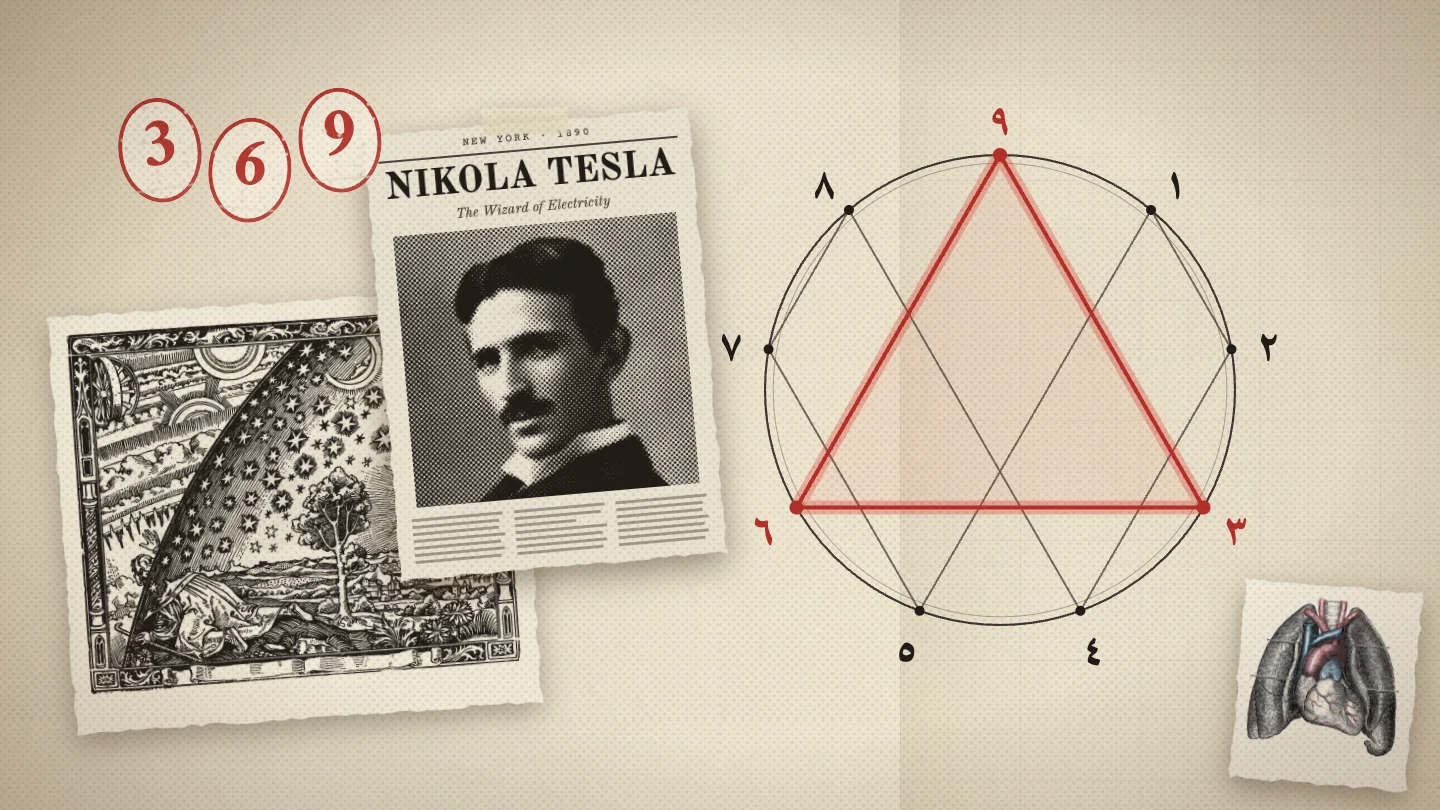
Nikola Tesla was obsessed with three numbers: 3, 6 and 9. The line you'll see everywhere is "If you only knew the magnificence of the 3, 6 and 9, then you would have a key to the universe." I should be honest about one thing before going further: nobody has found that sentence in Tesla's letters, interviews or patents. It's attributed to him, widely, and that's all we can say for sure. His biographers do describe a real fixation on the number 3, like walking around a block three times before going into a building.
The idea behind the quote is that these numbers sit at the base of how things are built, in patterns that repeat and fit together. Whether or not Tesla said it in those words, it stuck with me.
Where the idea came from
A while ago I started wondering what would happen if I breathed in that rhythm. Most faiths and traditions treat the breath as a key to the soul, to how we feel and how we carry ourselves. In Arabic the link is right there in the language: نَفَس (breath) and نَفْس (the self, the soul) are written with the same letters. Latin has the same thing with spiritus, which meant breath before it meant spirit.
So I put the two keys together. The breath on one side, Tesla's 3, 6 and 9 on the other. Could that bring a bit more harmony between what's going on inside us and the world outside? I made a breathing exercise to find out, and I called it Tesla Breathing. It's now in the Okaz app.
How it works
Each round is simple:
Breathe in for 3 seconds.
Hold the breath gently for 6 seconds.
Breathe out slowly for 9 seconds.
That's 18 seconds per round. In the app there are three versions: 6 rounds (about 2 minutes), 18 rounds (about 5 and a half) and 54 rounds (about 16). The round counts aren't random either. Six rounds of 18 seconds is 108 seconds, and 1+0+8 = 9. Eighteen rounds is 324 seconds, and 3+2+4 = 9. Fifty-four rounds is 972 seconds, 9+7+2 = 18, and 1+8 = 9. Every version lands back on Tesla's 9.
What the science says
Leaving the number symbolism aside, the breathing pattern itself does something you can measure. When your out-breath is longer than your in-breath and you keep that up steadily, you lean on the parasympathetic nervous system, the "rest and digest" side that slows the heart and settles the body. Your heart rate already drops a little every time you exhale; a long, slow exhale gives it more room to do that.
A 2018 systematic review by Zaccaro and colleagues looked at 15 studies of slow breathing, under 10 breaths a minute, in healthy people. Slow breathing went with higher heart rate variability, calmer brain activity and people reporting less anxiety and arousal. Tesla Breathing sits well inside that range, at a bit over 3 breaths a minute. The review was small, and it covered slow breathing in general rather than this exact pattern, so take it as support for the direction, not a promise.
About the 528 Hz music
To add to it, the guided sessions in the app play background music built around 528 Hz. This comes from a 2018 study by Akimoto and colleagues, "Effect of 528 Hz Music on the Endocrine System and Autonomic Nervous System". Nine healthy adults listened to piano music tuned so that it included 528 Hz, and on another day the same music at standard tuning. After the 528 Hz version, their cortisol, the stress hormone, went down, and they felt less tense. The effect showed up after only about five minutes of listening.
Nine people is a very small study, and nobody has shown that 528 Hz works the same way for everyone. I like the music and I find it helps, so I put it in. If you want the full effect, wear headphones while you breathe.
528 and Tesla's numbers
One more thing I noticed: 5+2+8 = 15, and 1+5 = 6. So 528 comes back to one of Tesla's numbers too. Maybe that's a coincidence. Maybe the man was right to keep his eye on these numbers. I'll leave that one with you.
Try it
Find it in the app under Watch, then Breathing techniques, then Tesla Breathing. Start with 6 rounds.
Sit somewhere comfortable. Don't do it while driving, in water, or anywhere you need to stay alert.
Keep the hold soft. You're pausing, not straining. If 6 seconds feels like too much at first, shorten it and build up.
If you feel dizzy, lightheaded or short of breath, stop and breathe normally.
If you're pregnant, or you have a heart or lung condition or panic attacks, check with your doctor before practising breath holds.
My suggestion: give it at least a week, 18 rounds a day, which is about five minutes. Don't judge it after one session. Your own experience is the key to knowing whether it does anything for you, so try it honestly and give it a fair chance.